Nickel 201 Fasteners Manufacturer in India
UNS N02201 Nickel Bolts, Nuts & Studs: Material Standards, Threads, Inspection and Practical Buying Guide by Arrow Piping
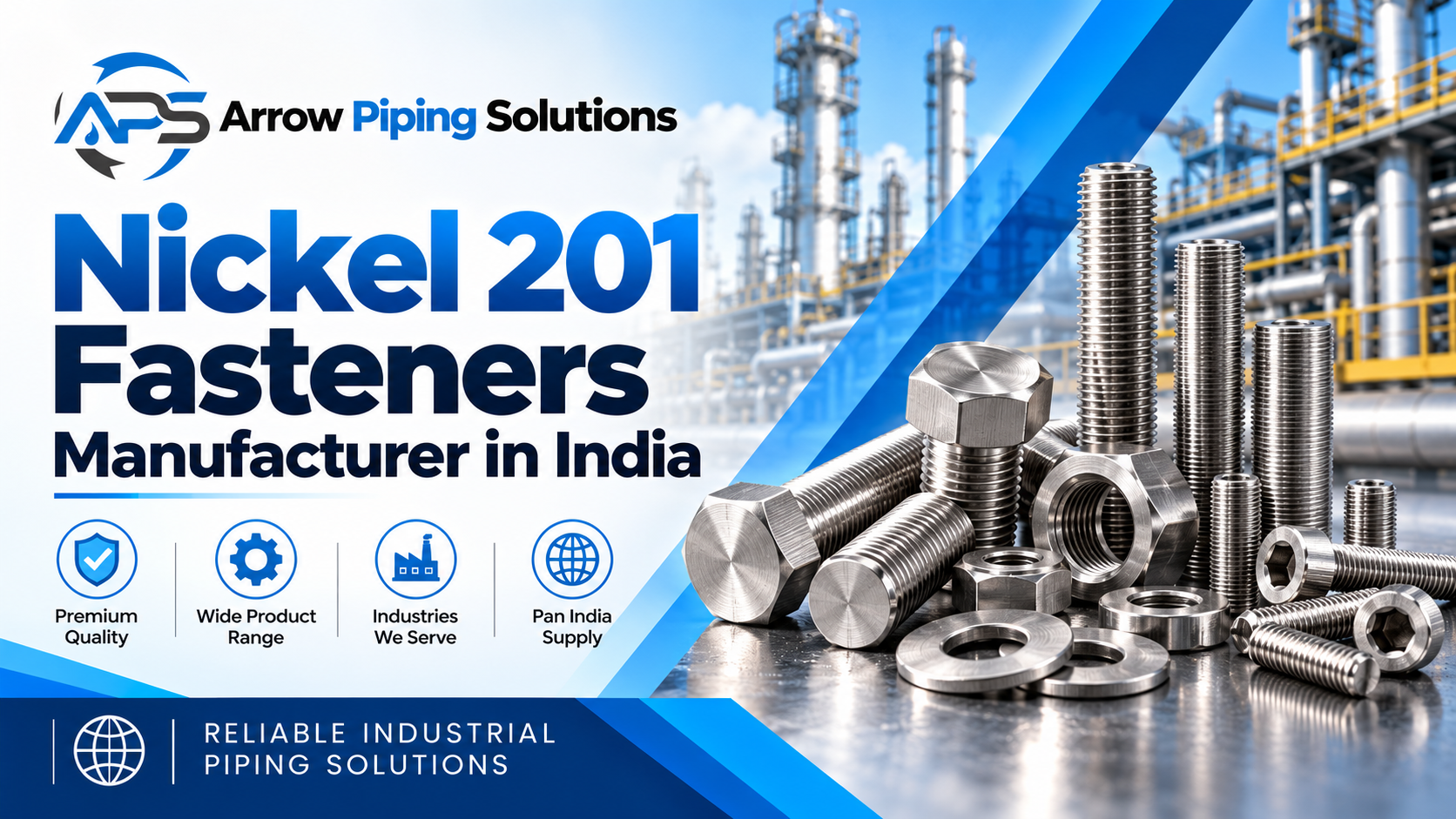
Nickel 201 fastener sourcing starts with the correct UNS grade, drawing, thread detail and heat traceability. The existing image path is preserved to avoid changing assets; update the actual photograph separately before publication.
Looking for a Nickel 201 Fasteners Manufacturer in India? A bolt described only as “Nickel 201, M12” is not fully specified. Buyers still need to decide the thread pitch, length measurement, mating nut, condition and which test records must accompany the order.
Arrow Piping is the contact company for this guide. Use the checklist below to write a meaningful enquiry for low-carbon nickel bolts, hex nuts, stud bolts or washers. Confirm manufacturing origin, availability and certificates directly for your actual requirement.
1. What Are Nickel 201 Fasteners?
Quick answer: Nickel 201 fasteners are joining components manufactured from UNS N02201, a commercially pure nickel alloy with controlled low carbon. Common forms include bolts, threaded studs, nuts and custom fastening pieces. Their suitability depends on the material, finished geometry and the joint design together.
Nickel 201 is often considered where nickel's behavior in appropriate alkaline or reducing environments is useful. It is not automatically suitable for every corrosive service, temperature or load.
2. Nickel 201 Material Designation and Relevant Standards
Keep the alloy specification separate from the finished fastener specification. A rod test report tells you what bar the fastener may have come from; it does not, by itself, confirm the completed bolt's threads or strength.
| Reference | What It Covers | Buyer Check |
|---|---|---|
| UNS N02201 | The low-carbon Nickel 201 alloy designation. | Match the grade and heat chemistry with the order. |
| ASTM B160 / ASME SB-160 | Nickel rod and bar, including UNS N02201, used as possible fastener feedstock. | This is a raw-material specification, not a complete finished-bolt standard. |
| ASTM F468 | Specified nonferrous bolts, hex cap screws and studs. | Verify that the applicable edition and grade/class actually cover the proposed product; do not assume blanket Nickel 201 coverage. |
| ASTM F467 | Specified nonferrous nuts. | Confirm material and finished-nut scope against the actual edition and order. |
| ASME B18 / ISO fastener drawings | Relevant dimensional conventions for selected fastener forms. | Identify the exact standard, size, head form and length definition. |
| ASME B1 / ISO thread standard | Thread profile, pitch, tolerance and fit as invoked. | Do not mix metric and UNC/UNF callouts. |
3. Nickel 201 vs Nickel 200: The Carbon Difference
Both grades are commercially pure nickel, but Nickel 201 has a maximum carbon content of 0.02%. That lower carbon limit is relevant to certain elevated-temperature conditions. It also makes the alloy attractive for some cold-formed parts. This does not assign an automatic fastener strength class or maximum working temperature.
| Check | Nickel 201 | Nickel 200 |
|---|---|---|
| UNS | N02201 | N02200 |
| Carbon | 0.02% maximum | Higher permitted carbon content under its specification |
| High-temperature selection | Often preferred over Nickel 200 for some exposure above approximately 315°C, subject to engineering assessment | Can present carbon-related concerns in certain sustained high-temperature uses |
| Purchasing rule | Order and verify the exact grade | Never substitute without design approval |
4. Chemical Composition and Material Properties
For UNS N02201, common published chemistry limits include nickel plus cobalt at least 99.0% and carbon no more than 0.02%. Other controlled elements include iron, copper, manganese, silicon and sulfur. Check the applicable ordered standard and heat-specific report for actual compliance.
| Property | Practical Meaning | What to Verify |
|---|---|---|
| Low carbon | Characteristic distinction from Nickel 200. | Actual carbon result on a traceable heat analysis. |
| Ductility and cold forming | Can be useful in formed components, depending on condition and method. | Fastener manufacturing process and final condition. |
| Corrosion behavior | Potential usefulness in selected alkali or reducing conditions. | Fluid impurities, concentration and temperature. |
| Mechanical strength | Varies by processing and condition; typical annealed-bar values are not bolt ratings. | Actual required mechanical properties and test method. |
| Ferromagnetism | Nickel 201 may respond to a magnet. | Use documentation and chemistry rather than a magnet test for identification. |
5. Types of Nickel 201 Fasteners Buyers Commonly Specify
| Fastener Type | Typical Use | Must-Specify Details |
|---|---|---|
| Hex head bolts | Flanged joints and equipment connections where the design permits. | Across-flats/head standard, diameter, length, thread and property requirements. |
| Hex nuts | Mating components for bolts and studs. | Thread fit, height, across-flats dimension and matching mechanical requirements. |
| Stud bolts / threaded rods | Equipment and pipe-flange assembly. | Overall length, full or partial thread, two-end requirements and nuts per stud. |
| Socket head screws | Compact machinery assemblies when approved. | Head/drive geometry, engagement length and required strength. |
| Washers and special items | Load distribution or drawing-specific connections. | OD, ID, thickness, hardness/condition and approved drawing. |
These are enquiry categories, not a claim that every form or size is currently manufactured or stocked by Arrow Piping.
6. Threads, Dimensions and Fits: The Details That Prevent Rework
A recurring enquiry problem is writing “M16 Nickel 201 stud” without specifying pitch or length. A metric coarse thread and a fine thread of the same nominal diameter do not mate. Neither does a UNC bolt automatically mate with a metric nut.
| PO Field | Example Wording (Illustrative Only) | Why It Matters |
|---|---|---|
| Material | Nickel 201 / UNS N02201 | Controls alloy identity. |
| Component | Fully threaded stud with two matching nuts | Prevents nut quantity ambiguity. |
| Size and thread | M12 × 1.75, selected ISO thread tolerance | Defines pitch and required fit. |
| Length | 100 mm overall stud length | Avoids confusion about bolt vs stud measurement. |
| Quantity | 50 studs, 100 nuts | Makes pricing and packing comparable. |
| Documents | Traceable MTR plus agreed finished-part inspection | Aligns acceptance requirements. |
The example above is not an availability statement or design recommendation. Confirm thread tolerance, engagement, tightening method and corrosion compatibility with the engineer responsible for the joint.
7. Finished Fastener Testing and Heat Traceability
Do not treat a raw-bar certificate as evidence that every finished thread has been checked. Machining, forming and heat treatment can affect the finished component. Your purchase order should define what has to be demonstrated.
| Inspection Point | Acceptable Question to Ask | Typical Mistake |
|---|---|---|
| Material test report | Can the heat number be traced to UNS N02201 chemistry? | Accepting a generic data sheet. |
| Carbon verification | Is the carbon result on the laboratory report? | Relying on handheld PMI alone for low carbon. |
| Mechanical evidence | Which properties and test results apply to the finished part? | Using annealed rod values as a bolt rating. |
| Thread inspection | Are pitch, tolerance and gauging requirements agreed? | Checking only the nominal diameter. |
| Marking and packing | How will sizes, lot numbers and heats remain identifiable? | Mixing unlabelled nuts and studs. |
| Additional inspection | Is third-party witnessing or additional testing written into the PO? | Requesting it only after production. |
8. Where Are Nickel 201 Fasteners Considered?
a) Caustic Alkali Handling Equipment
Nickel 201 may be evaluated for selected caustic-service equipment, subject to concentration, contaminants and process temperature. A suitable alloy alone does not ensure a leak-tight bolted joint.
b) Chemical Processing Assemblies
Fasteners may be used in selected process units and corrosion-conscious assemblies. Check crevices, galvanic couples, cleaning chemicals and local temperature, not just the bulk process fluid.
c) Electrical and Specialty Fabrication
Commercially pure nickel's physical characteristics can be useful for certain electrical or fabricated components. Confirm that a threaded fastening design is actually needed rather than a different nickel product form.
d) Thermal Equipment
The low-carbon composition can be relevant in some elevated-temperature environments. Bolt load relaxation, thermal expansion, mating materials and applicable design rules still need calculation.
9. Common Purchasing Mistakes with Nickel 201 Bolts and Nuts
Quick Buyer Checklist
- Vague grade: Replace “Nickel 200/201” with the approved UNS N02201 requirement.
- Wrong standard: ASTM B160 covers rod/bar feedstock, not automatically a completed fastener.
- Unclear thread: Specify metric or inch series, pitch, class/tolerance and handedness if nonstandard.
- No nut match: Define matching nuts and washers separately, including material and quantity.
- Wrong length convention: Clarify under-head bolt length versus full stud length.
- Missing certification: Agree MTR, heat identification and any finished-part tests before ordering.
- Assumed availability: Confirm manufacture, finish, order minimum and lead time in writing.
10. Nickel 201 Fastener Price and Lead-Time Factors
Two offers may look comparable but cover different finished parts. Machining complexity, component count, unusual threads, raw material availability, inspection scope and packing all affect quotations. Compare the same bill of materials, not merely a per-piece price.
Practical tip: Send one spreadsheet row per size. Put the nut and washer counts in separate columns. This saves back-and-forth and reduces mistakes in dispatch documents.
If delivery is international, also confirm destination, required export documentation, packaging, Incoterms and inspection hold points. None of these should be inferred from the alloy name.
11. How to Prepare a Useful Nickel 201 Fastener Enquiry
Start with the approved drawing or bill of materials. Include: UNS N02201, component type, dimensions, thread, quantity, material condition, mating parts, marking, inspection records and delivery address. If the joint is safety-critical, include the engineer-approved mechanical requirements instead of asking the seller to guess a bolt grade.
Need a Nickel 201 fastener quotation? Send your requirements to Arrow Piping with drawings, quantities and inspection expectations. Ask for written confirmation of product scope, availability and documents.
12. Why Contact Arrow Piping for Nickel 201 Fastener Enquiries?
Arrow Piping is the enquiry contact for this guide. Sharing complete drawings and material details helps the team evaluate a request without making assumptions about the grade, threads or required tests. Confirm manufacturing origin, lead times, test documents and commercial terms specifically for your order.
Sticky Q&A: Quick Answers for Nickel 201 Fastener Buyers
Eight concise answers to recurring technical and procurement questions.
Q1. What are Nickel 201 fasteners?
Nickel 201 fasteners are bolts, nuts, studs and related threaded components made from low-carbon commercially pure nickel, UNS N02201. Specify the component dimensions, threading, condition and documented chemistry rather than ordering by grade name alone.
Q2. Which ASTM standard applies to Nickel 201 fasteners?
ASTM B160 covers Nickel 201 rod and bar feedstock, not every finished-fastener requirement. The purchase order must also specify relevant finished-fastener dimensions, threads, mechanical requirements and testing; check the scope and grade coverage of any proposed fastener standard.
Q3. What is the difference between Nickel 200 and Nickel 201 fasteners?
Nickel 201 (UNS N02201) has a maximum carbon level of 0.02%. Nickel 200 (UNS N02200) permits more carbon. Do not interchange them solely because both are called commercially pure nickel; review the specified application.
Q4. Can Nickel 201 bolts be used in caustic soda equipment?
Nickel 201 can be considered for selected caustic alkali environments. Actual suitability depends on concentration, operating temperature, contaminants, stress and joint design. An engineer should verify the complete service conditions.
Q5. What details should I send for a Nickel 201 bolt or stud enquiry?
Provide UNS N02201, fastener type, diameter, length, thread standard and pitch, quantity, nuts or washers required, mechanical condition, drawing, certificates and delivery destination.
Q6. How do buyers verify Nickel 201 fastener material?
Request heat-traceable material test reports showing chemical analysis, particularly carbon, along with applicable mechanical test results. Agree on PMI or extra inspection in writing; handheld PMI alone may not reliably confirm the low carbon limit.
Q7. Are ASTM B160 and ASTM F468 interchangeable?
No. ASTM B160 specifies nickel rod and bar raw material; ASTM F468 addresses certain nonferrous bolts, hex cap screws and studs. Verify the specific grade, product form and edition coverage before referring to either in a purchase order.
Q8. How can I request a Nickel 201 fastener quotation from Arrow Piping?
Send a component-wise list showing grade, drawing or standard, size, thread, finish, quantity, inspection documents and destination. Ask Arrow Piping to confirm availability, manufacturing source, lead time and supply scope in writing.
Field Note for the Arrow Piping Technical Team
Suggested technical-team wording for review and approval: “Before approving a Nickel 201 fastener quote, match the UNS grade, carbon report, actual thread callout and finished-part inspection plan. A rod certificate alone does not tell you whether the nut will fit the stud.”
This is proposed editorial wording for Arrow Piping to approve; it is not presented as a verified employee quotation.
Conclusion: Buy the Right Joint, Not Just the Right Nickel Grade
When comparing a Nickel 201 Fasteners Manufacturer in India, request more than a price for “nickel bolts”. UNS N02201, correct threads, mating components, defined material condition and heat-traceable documentation make supplier offers easier to assess and help prevent avoidable assembly issues.
Email inquiry@arrowpiping.co.in or use the Arrow Piping contact page with your item list and any approved drawings.